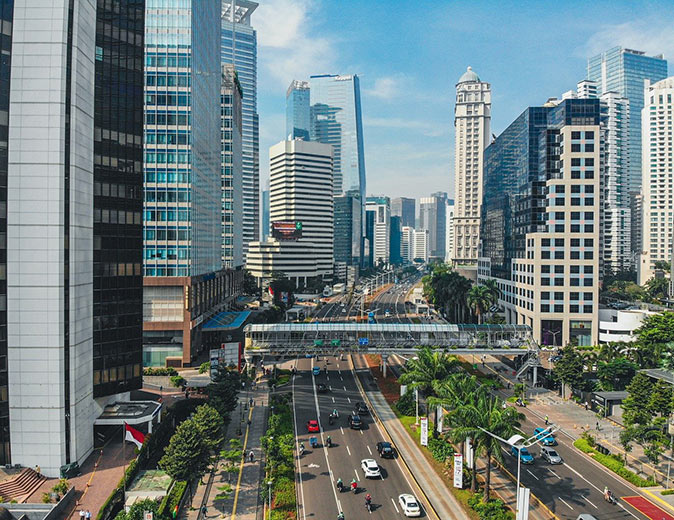
Indonesia is a potential market that has a lot of opportunities for businesses to explore. The Indonesian market has a population of over 275 million people and is the world’s fourth most populated country. The working-age population in Indonesia also continues to increase, which in turn encourages more eagerness in terms of consuming goods and services for their needs.
In this article, we discuss Indonesia’s market potential and its strong points over other ASEAN countries, which can be a reason to do business in Indonesia. So, if you are one of those who are interested in doing business in Indonesia, make sure you read this post!
The largest economy in Southeast Asia
Indonesia’s economy has grown at a steady rate over the past few years. Although it contracted in 2020 due to the COVID-19 pandemic, in 2021 the Indonesian economy improved again and even surpassed pre-pandemic conditions. This year made Indonesia the country with the highest economy in terms of GDP in Southeast Asia with a nominal value of 3,53 trillion USD. This positive trend in GDP is expected to continue until 2030 to reach 5,59 trillion USD GDP (PPP) and make Indonesia the 5th largest economy in the world1. This stable economic potential will help investors and businesses in planning their savings, spending, and investment activities.
Dominance of the consumer market due to massive income growth
Indonesia’s working population, which is defined as people within the age range of 15 to 64 years old, is set to grow by 13 million people by 2030. This figure is the largest growth compared to other countries in ASEAN (56% of ASEAN growth). This is followed by the Philippines (9 million), and Malaysia and Vietnam (2 million each). This growing workforce presents an opportunity for businesses and companies to tap into.
Alongside the growing of working age population, the increase in the number of Middle-class and Affluent Consumer (MAC) in ASEAN-6 countries (Indonesia, Malaysia, Philippines, Singapore, Thailand, and Vietnam) is also striking. Middle-class is defined as households with an income range from $10,001-$24,000, while affluents are households with an income exceeding $24,000. Based on analysis from the Boston Consulting Group, the population figures in MAC increase steadily and Indonesia has the strong growth of CAGR of 5,2%. However, the Indonesian market has become dominant in ASEAN-6 in term of the total MAC population of 115M (42%) in 2017 and is estimated to increase to 222M (47%) by 2030.
This demographic change will result in a shift in greater consumption habits and preferences. BCG research reveals that the mass affluent already constitute a critical market. In Indonesia, the affluent already account for a significant amount of all spending on restaurants (42%); leisure and travel (46%); watches, jewellery, and eyewear (49%); and cars (53%). The mass-affluent class is also particularly resilient during difficult economic times. While most consumers tighten their budgets during economic slowdowns, the spending of these consumers tends to remain steady or continue to increase.
More competitive in investment destination
As a ‘Magnet’ for Investment Destination in SEA, Indonesia recorded competitive gains in terms of foreign direct investment (FDI) compared to countries in ASEAN. With a FDI value of 20 billion USD, Indonesia is the second contributor country after Singapore in terms of FDI in ASEAN. Moreover, specific on tech investment, Indonesia is the second highest country after Singapore, which contributes 34%, followed by Vietnam at 10%, and 10% from other countries. In addition, in terms of FDI per capita, Indonesia still has significant room for growth compared to ASEAN-5 countries (Indonesia, Malaysia, Singapore, Thailand, and Vietnam). This potential can still be utilized by foreign investors to be developed in Indonesia. In recent years, numerous projects have been invested in Indonesia although in 2022 it has decreased due to the global economic slowdown.
Constant foreign and tech project investment in recent years
| 2019 | 2020 | 2021 | H1 2021 | H1 2022 | |
|---|---|---|---|---|---|
| Tech Deals | 355 | 437 | 649 | 300 | 302 |
| FDI Projects | 30.354 | 59.118 | 60.811 | 47.041* | 27.591* |
Furthermore, government regulations also continue to encourage an increase in foreign investment through legal certainty that allow companies to be 100% owned by foreign investors in many sectors. The government also provides convenience to potential investors in terms of licensing system by implementing an Online Single Submission Risk Based Approach (OSS-RBA). In addition, the Indonesian government also recognizes the need for a special strategy to attract potential investors by offering fiscal incentives for businesses including tax incentives on special economic zones2, one of the priority policies lists to attract foreign investors. These are the reasons why the Indonesian market is attractive to do business. It is not surprising that Indonesia’s ease of doing business (EODB) index has performed progressively with a ranking of 129 in 2013 to 73 in 2020.
Considering the Indonesian market, which is the largest economy in Southeast Asia, is the right thing for potential investors with promising growth potential. With its dominance in terms of consumption in Southeast Asia because of large population and strong household income increases, it provides opportunities for various businesses to expand their operations in Indonesia. Moreover, Indonesia is a proven investment destination with progressive EODB index, adding with government support through policy and fiscal incentives. By understanding the opportunities and strong point of Indonesian market, potential investors will be attracted and able to invest properly. We hope this article gives you insights into one of the preferred countries for doing business.
1Projected by the Lowy Institute Asia Power Index using 2021 baseline
2The incentive is valid only during the concession period
*January-September Period
Leave a Reply